

What a Real Unschooling Day Looks Like
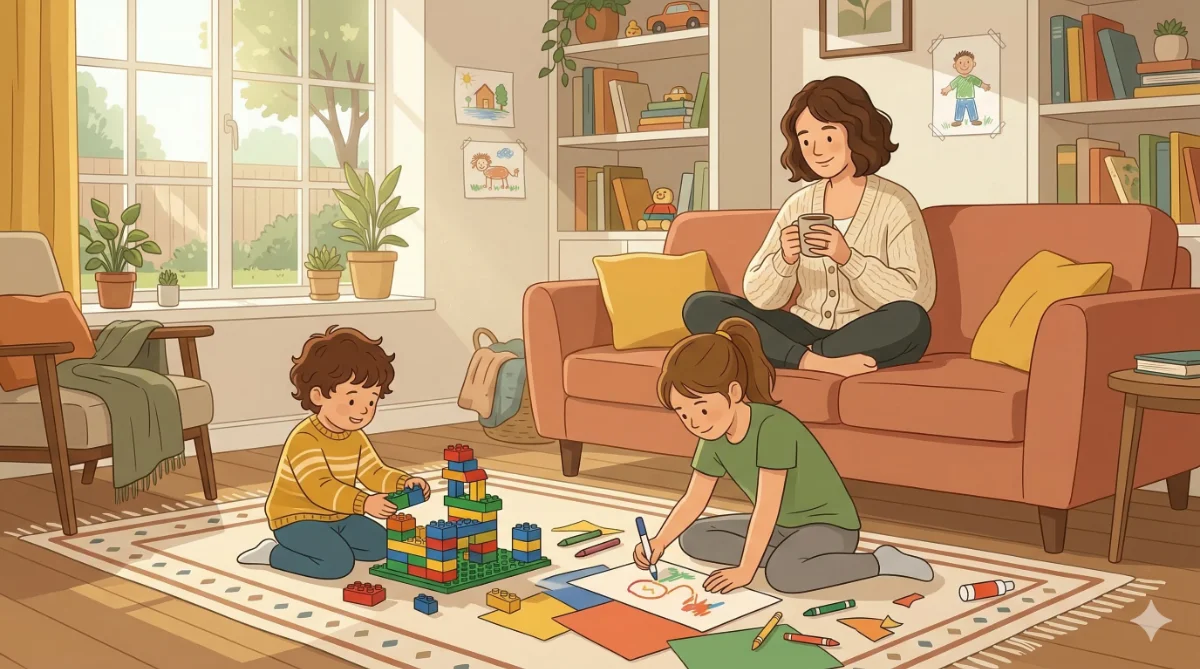
“But what do you DO all day?”
If you’re an unschooling family, you’ve heard this question a hundred times. From well-meaning relatives, curious neighbors, that one friend who keeps sending you articles about how kids “need structure.”
The honest answer? It depends on the day. Some days look like a nature documentary. Some days look like chaos. Most days are somewhere in between, and the learning happens whether or not it looks like school.
Here’s what a real Tuesday looked like at our house last week. No filters, no Pinterest-worthy setups, just regular life with two kids.
The Morning: Nobody Sets an Alarm
Our kids wake up when they wake up. For our 9-year-old, that’s usually around 8 AM. He stumbles downstairs, grabs a bowl of cereal, and parks himself in front of his computer. For his younger sister, it’s closer to 8:30, and she comes down with a stack of workbooks she picked out herself.
This is the part that makes traditional schooling families nervous. No schedule. No lesson plan taped to the fridge. No worksheets due by 9 AM.
But here’s what’s actually happening: our son is reading. Not assigned reading. He found a wiki about game design and he’s deep into an article about how Minecraft generates its worlds. He’s absorbing vocabulary, following complex logic, and teaching himself how procedural generation works. He’s nine. If we assigned him a reading comprehension worksheet on the same topic, he’d refuse. But because he found it himself, he’s been reading for 45 minutes without looking up.
His sister is filling out a math workbook. Not because we told her to, but because she genuinely likes the feeling of completing pages. She picks the subjects. She sets the pace. Today it’s multiplication. Yesterday it was a drawing tutorial from YouTube. The day before, she spent two hours designing outfits for paper dolls she cut out, which involved measurement, symmetry, and more math than most worksheets cover.
Late Morning: The Accidental Science Lesson
Around 10:30, our son comes running in to tell us he’s building a redstone calculator in Minecraft. He needs to understand binary to make it work.
This is the unschooling magic that’s impossible to plan for. A kid who “hates math” is voluntarily learning binary arithmetic because it’s the only way to finish his Minecraft project. We didn’t assign this. We couldn’t have. It emerged from following his interests until they ran straight into a real-world concept.
We sit down and talk through how binary works. He gets it in about 15 minutes because he’s motivated. Try teaching binary to a nine-year-old who doesn’t care. It takes a week and everyone’s miserable. Motivation changes everything about how fast kids learn.
Meanwhile, his sister has moved on to making friendship bracelets. She’s counting patterns, measuring lengths, and following a YouTube tutorial that requires reading and pausing at each step. Motor skills, math, reading comprehension, patience. All wrapped up in something she chose to do because it’s fun. She doesn’t know she’s “doing school.” She’s just making something she’s proud of.
What the Research Says
Lunchtime: The Grocery Store Classroom
We need groceries, so everyone piles into the car. Our daughter has the grocery list on a tablet and she’s checking items off as we find them. Our son is doing the price comparisons because he likes finding the best deal (and because we told him he could keep the savings for his allowance, which is the best math motivator we’ve ever found).
“Dad, the store brand is $2.49 for 32 ounces but the name brand is $3.79 for 24 ounces. Which one’s cheaper per ounce?” That’s unit pricing. That’s division. And he figured out the question himself because he wanted to. No worksheet. No textbook. Just a kid who wants to maximize his allowance.
At the deli counter, they both practice ordering for themselves. Social skills, manners, speaking clearly to an adult. Unschooling doesn’t mean we skip these lessons. It means they happen in real life instead of a worksheet about “how to talk to adults.”
Our daughter also noticed the bakery has a “buy 6 rolls for $3.50 or $0.75 each” sign and asked which was a better deal. She worked it out with some help from her brother. “Six times seventy-five cents is… four fifty? So the six-pack saves a dollar!” Real math, real context, real excitement about getting it right.
Afternoon: The Productive Chaos
After lunch, things get looser. Our son is back on his computer, now watching a YouTube video about how someone built a working CPU inside Minecraft. He’s taking notes. In a notebook. Voluntarily. If you’ve ever tried to get a nine-year-old to take notes on something you assigned, you’ll understand why we nearly fell off our chairs.
Our daughter has set up an art station at the kitchen table. She’s designing birthday cards for friends, which involves spelling names correctly, writing messages, and making design decisions about color and layout. When she asked how to spell “magnificent” (her word, not ours), we helped her sound it out. She wrote it on three different cards because she was proud she learned a big word.
We’re nearby, available but not hovering. This is the part of unschooling that’s hardest to explain: the parent’s job isn’t to teach. It’s to be a resource. When they have questions, we’re here. When they need supplies, we help. When they want to show us something, we pay attention. The paying attention part matters more than any lesson plan.
Sometimes they get bored. Boredom is fine. Boredom is where creativity starts. We don’t rush to fill every quiet moment with a lesson. Last Tuesday, the boredom led to our son inventing a card game with made-up rules that his sister immediately wanted to play. They spent an hour negotiating rules, keeping score, and arguing about whether a “dragon card” should beat a “robot card.” Negotiation, logic, social skills, basic probability. All from boredom.
Handling the Guilt
Let me be honest about something: there are days when it looks like nothing happened. Days when both kids played video games for four hours and the house is a mess and you think, “Are we ruining them?”
Every unschooling parent has these days. The guilt is real, especially when you see other families posting their homeschool schedules with color-coded subjects and completed worksheets.
Here’s what helps us: we keep a loose log. Not a curriculum tracker, just a notes app where we jot down what the kids did each week. When we look back at a month of entries, the patterns are obvious. They’re reading constantly. They’re solving problems. They’re building things, making things, asking questions, and pursuing interests deeper than any school assignment would take them.
The learning isn’t always visible in the moment. But it’s there. Last month’s log shows: binary arithmetic, unit pricing, friendship bracelet patterns (repeating sequences), a board game designed from scratch, three books read voluntarily, a Minecraft CPU, and enough craft projects to fill a gallery wall. That’s not “nothing.” That’s a full education disguised as regular life.
What We’d Tell You If You’re Considering This
Unschooling isn’t for every family. It requires trust, patience, and comfort with uncertainty. You have to be okay with your kid spending a week obsessed with something that seems “unproductive” and trust that the skills they’re building transfer.
It also requires a parent who’s available. Not standing over them with a lesson plan, but genuinely available. Present. Ready to answer questions, provide materials, and follow their curiosity wherever it goes. Some weeks that means buying supplies for an unexpected clay sculpture project. Other weeks it means sitting together for an hour talking about how computers work.
If that sounds like something you could do, even a few days a week, you might be surprised how much learning happens when you stop trying to force it.
Family Tip
Our family wouldn’t go back to traditional schooling. Not because unschooling is perfect, but because we’ve seen what our kids are capable of when they’re allowed to drive their own education. The Minecraft calculator kid and the friendship bracelet designer are doing just fine.